
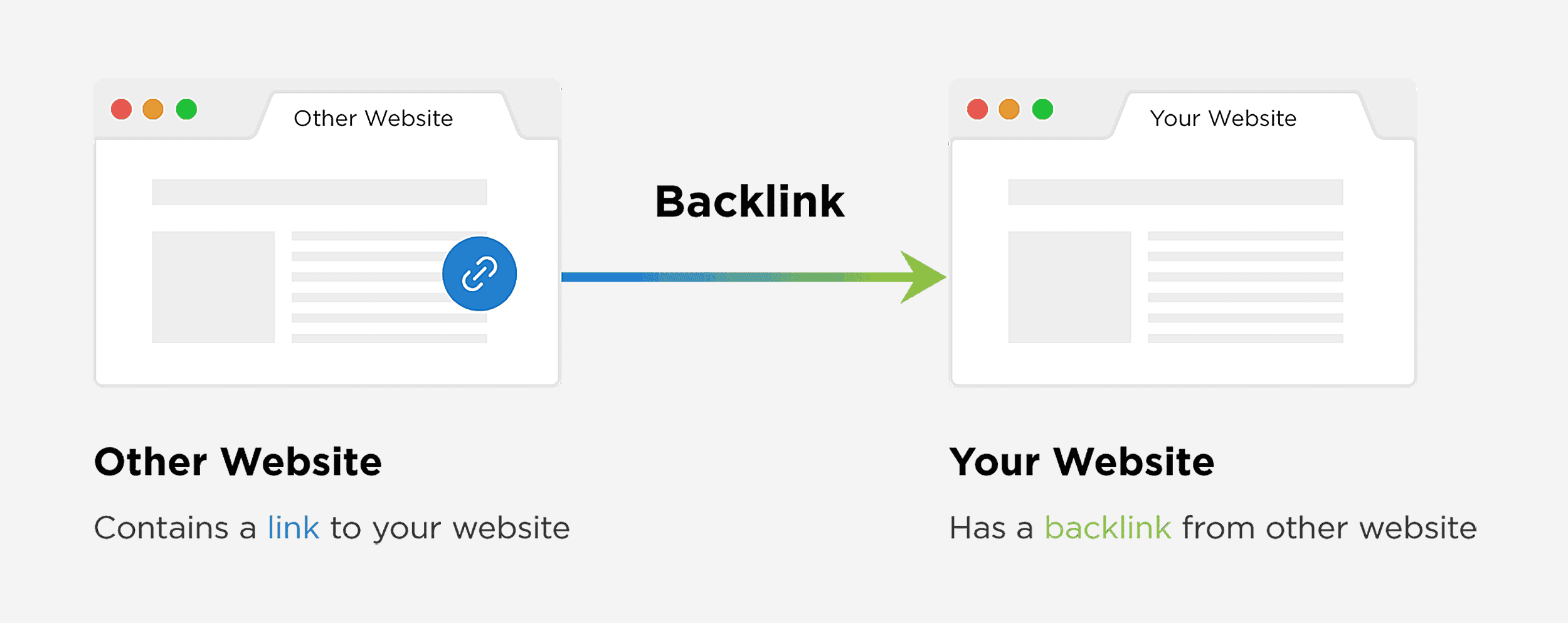
In SEO, the opposite of backlinks (links coming to your website from other sites) is generally:
🔁 Outbound Links (External Links)
Outbound links are links from your website to another website.
-
Backlink (Inbound Link):
Another website → your website -
Outbound Link (External Link):
Your website → another website
Related Terms (Sometimes Confused)
-
Internal Links – Links between pages on your own site (not the opposite, just different).
-
Referring Domains – The websites that give you backlinks.
-
Incoming vs Outgoing Links – Another way to describe backlinks vs outbound links.
Quick Example
If:
-
A blog links to your homepage → That’s a backlink for you.
-
You link to Wikipedia in your article → That’s an outbound link.
If you’d like, I can also explain how outbound links affect SEO differently from backlinks.
Great — let’s break down how outbound links affect SEO vs backlinks in a clear, practical way.
🔗 Backlinks (Inbound Links)
Definition: Links from other websites pointing to your site.
✅ SEO Impact: Very Strong (Ranking Factor)
Backlinks are one of Google’s most important ranking signals.
Why They Matter
-
📈 Increase domain authority
-
🏆 Improve rankings
-
👑 Act as “votes of trust”
-
🚀 Help new pages get indexed faster
Example
If Forbes links to your website → Google sees that as credibility.
Quality Matters More Than Quantity
-
Relevant sites > Random sites
-
High-authority sites > Low-quality directories
-
Natural links > Spammy links
🌍 Outbound Links (External Links)
Definition: Links from your website to another website.
✅ SEO Impact: Indirect (But Important)
Outbound links do not directly boost your rankings like backlinks do — but they still matter.
Why They Help
-
🧠 Show topical relevance
-
📚 Improve content credibility
-
🤝 Build relationships with other sites
-
🔍 Help search engines understand your content context
Google has stated that linking to high-quality, relevant sources is a good practice.
⚖️ Quick Comparison
| Factor | Backlinks | Outbound Links |
|---|---|---|
| Direct ranking impact | ⭐⭐⭐⭐⭐ | ⭐ |
| Authority building | Yes | No (indirect only) |
| Trust signal | Strong | Mild |
| You control it? | No | Yes |
🚨 Important SEO Tips
For Backlinks:
-
Focus on earning links naturally through high-quality content.
-
Avoid buying spammy backlinks (can cause penalties).
For Outbound Links:
-
Link to reputable, relevant sources.
-
Avoid linking to spammy or irrelevant sites.
-
Use
nofollowfor paid or affiliate links.
🎯 Bottom Line
-
Backlinks = Authority fuel.
-
Outbound links = Credibility and context.
If you want, I can also explain how internal links compare to both — that’s where many SEO gains are actually hiding.
Perfect — this is where a lot of SEO gains are hiding 👀
Let’s compare Internal Links vs Backlinks vs Outbound Links clearly and practically.
🔗 1. Internal Links (Your Secret SEO Weapon)
Definition: Links from one page on your site to another page on your site.
Example:
Your blog post → links to your service page.
✅ SEO Impact: Very Strong (Fully Under Your Control)
Internal linking helps Google:
-
🧭 Understand your site structure
-
🏗 Discover new pages
-
⚖ Distribute “link equity” (authority)
-
🎯 Understand which pages are most important
🔥 Why Internal Links Are Powerful
Unlike backlinks:
-
You control anchor text
-
You control placement
-
You control volume
-
No outreach required
You can boost rankings just by improving internal linking.
📊 Full Comparison
| Factor | Backlinks | Internal Links | Outbound Links |
|---|---|---|---|
| Direct ranking power | ⭐⭐⭐⭐⭐ | ⭐⭐⭐⭐ | ⭐ |
| You control it? | ❌ No | ✅ Yes | ✅ Yes |
| Builds authority | Yes | Redistributes authority | No |
| Helps indexing | Yes | Yes (strongly) | No |
| Risk of penalty | If spammy | Rare | If linking to spam |
🧠 How Internal Linking Actually Boosts Rankings
Imagine:
-
Page A has 20 strong backlinks.
-
Page B has none.
-
You internally link Page A → Page B.
Page B now inherits some authority.
That’s called link equity flow.
🏗 Best Internal Linking Strategy
1️⃣ Use Descriptive Anchor Text
Instead of:
Click here
Use:
Learn more about technical SEO audits
2️⃣ Link to Important Pages More Often
Your:
-
Money pages
-
Service pages
-
High-converting pages
Should receive more internal links.
3️⃣ Create Topic Clusters (Very Powerful)
Structure example:
Main Guide (Pillar Page)
→ Links to smaller detailed articles
→ Those articles link back to the pillar
This builds topical authority.
🚀 SEO Power Ranking (From Strongest to Weakest)
-
🥇 High-quality backlinks
-
🥈 Smart internal linking
-
🥉 Outbound links
🎯 Bottom Line
-
Backlinks build authority.
-
Internal links distribute authority.
-
Outbound links build credibility.
If you’d like, I can show you a simple internal linking structure you can apply to your website right away.
Great — here’s a simple, high-impact internal linking structure you can apply immediately to almost any website 👇
🏗 The 3-Layer Internal Linking Model
This works for:
-
Blogs
-
Service businesses
-
E-commerce
-
Affiliate sites
-
SaaS
🥇 Layer 1: Pillar Page (Main Topic Page)
This is your most important page for a topic.
Examples:
-
“Complete Guide to Technical SEO”
-
“Ultimate Beginner’s Guide to Investing”
-
“Digital Marketing Services”
What It Does
-
Targets a broad, high-volume keyword
-
Links out to supporting articles
-
Receives the most internal links
🥈 Layer 2: Supporting Articles (Cluster Content)
These target narrower, long-tail keywords.
Example (if pillar = “Technical SEO Guide”):
-
“How to Fix Crawl Errors”
-
“What Is Schema Markup?”
-
“How to Improve Page Speed”
What They Do
-
Link back to the pillar page
-
Link sideways to related cluster articles
-
Occasionally link to conversion pages
🥉 Layer 3: Conversion Pages (Money Pages)
Examples:
-
Contact page
-
Service page
-
Product page
-
Free trial page
These should receive internal links from:
-
Pillar pages
-
High-traffic blog posts
-
Relevant cluster articles
🔄 How It Flows (Visual Structure)
        [ Pillar Page ]

         ↙    ↓    ↘

   [Article] [Article] [Article]

        ↘        ↓        ↙

       [ Service / Money Page ]
Authority flows:
-
From backlinks → to pillar
-
From pillar → to cluster content
-
From cluster → to money pages
🎯 Step-by-Step Implementation
Step 1: Identify Your Top 5 Important Pages
Usually:
-
Core services
-
High-profit products
-
Main landing pages
Step 2: Add 3–5 Internal Links Per Article
Every blog post should:
-
Link to 1 pillar page
-
Link to 1–2 related articles
-
Link to 1 relevant service page (if natural)
Step 3: Fix Orphan Pages
Orphan pages = pages with zero internal links pointing to them.
These barely rank.
🧠 Pro Tips (Most People Don’t Do These)
✅ Link From High-Traffic Pages First
Find your top traffic pages → add links to important pages.
That moves authority fastest.
✅ Use Keyword-Rich Anchor Text (Naturally)
Instead of:
Learn more here
Use:
Our technical SEO audit service
✅ Don’t Overdo It
5–15 internal links per 1,000 words is healthy.
Don’t spam.
🚀 Quick SEO Wins You Can Do This Week
-
Add internal links from your homepage to money pages.
-
Add internal links from your top 3 traffic blog posts.
-
Build 1 strong pillar page for your main topic.
-
Audit for orphan pages.